Loading image...

Radiant Heaters
Warmth, without compromise
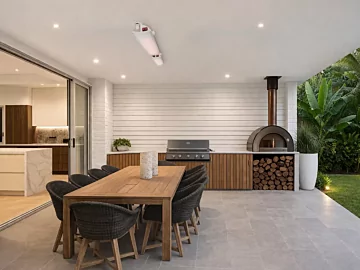
Radiant heaters deliver targeted warmth with even heat distribution, with no drafts and no cold spots, creating a quiet, allergy‑friendly ambience indoors and out. Engineered with infrared technology, HEATSCOPE® radiant heaters pair energy‑efficient performance with refined design, offering fast, comfortable heat and lower running costs for contemporary spaces.
Models
Showing 2 items of 2
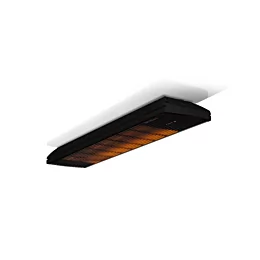
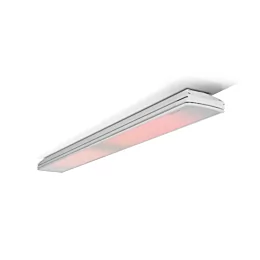
Spot 2800W Electric Radiant Heater
Vision 3200W Electric Radiant Heater

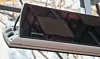
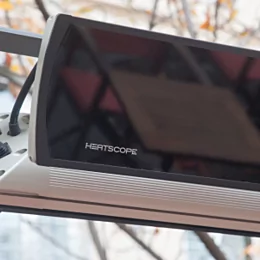
Loading image...

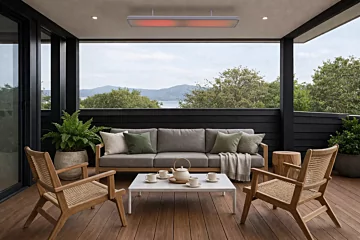
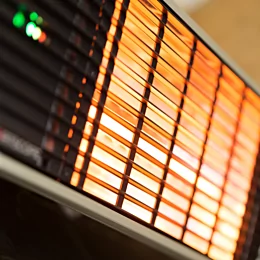
Carbon spiral heating technology
Dual carbon heating spirals power our radiant heaters with reduced visible light and a naturally cosy feel.
Loading image...


Energy‑efficient radiant heaters
HEATSCOPE radiant heaters convert 90–94% of energy into ambient warmth for low running costs and high comfort.
Loading image...

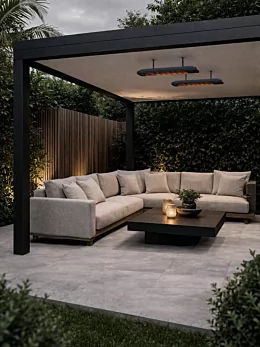
Rapid heat‑up times
Spot radiant heaters reach full output in about 15 seconds; Pure and Vision models ramp quickly owing to the glass‑ceramic front.
Two‑stage output control
Radiant heaters with 50% and 100% output modes via remote or hardwire for precise zone heating and energy optimisation.
Loading image...

Outdoor‑ready IP protection
Pure radiant heaters are IP65 rated for exposed installs; Spot and Vision are IP24 for well‑covered areas.
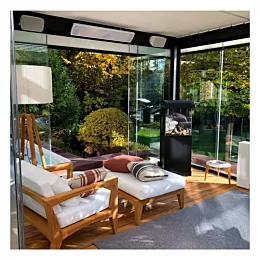
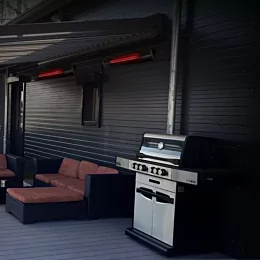
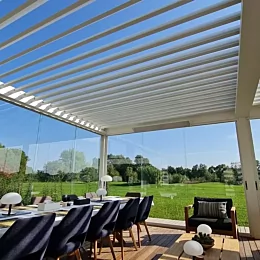
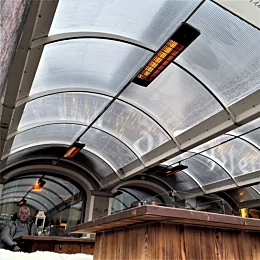
Styled by Our Clients
Loading image...
Loading image...
Loading image...
Loading image...

Loading image...
Loading image...
Loading image...
Loading image...
Learn More
Radiant Heaters
Outdoor Radiant Heaters
FAQ's
How much does it cost to run a HEATSCOPE® outdoor heater per hour?
Running a weather-resistant HEATSCOPE outdoor radiant heater costs roughly the heater's wattage divided by 1,000, multiplied by your local electricity rate per kWh. A 3,000 W heater run for one hour uses 3 kWh, so at an illustrative rate of $0.20/kWh it costs about $0.60 per hour to run.
Per-hour figures across the range, at the same illustrative $0.20/kWh rate:
- 1,600 W compact heater: $0.32/hour at full output, $0.16/hour at 50%
- 2,800 W heater: $0.56/hour at full output, $0.28/hour at 50%
- 3,000 W heater: $0.60/hour at full output, $0.30/hour at 50%
- 3,200 W heater: $0.64/hour at full output, $0.32/hour at 50%
Actual cost depends on your local electricity rate, so replace the illustrative figure with your own tariff for an accurate calculation. A two-hour session at full output on a 3,000 W heater sits near $1.20 at that rate; running the same session at the 50% setting drops the cost to around $0.60.
Mid-wave infrared technology converts up to 94% of energy directly into directed warmth, with minimal energy lost to air or wind dispersion. That efficiency, combined with permanent outdoor installation and weather-resistant construction, is what keeps the cost per comfortable hour low across patios, terraces, and hospitality settings.
How quickly do HEATSCOPE® outdoor heaters warm up?
HEATSCOPE weather-resistant infrared heaters reach full output in under 15 seconds on most models; the glass-fronted range reaches comfortable warmth in under 60 seconds. You feel the warmth almost the moment the heater switches on, because infrared radiation travels through the air like sunlight and warms people and surfaces directly rather than heating the surrounding atmosphere.
That direct-to-body transfer is why outdoor patio heating with infrared behaves differently from a gas patio heater or a fan heater. There is no lag while the air temperature climbs, and almost no heat loss to wind or open sides of a pergola. Two practical benefits follow:
- Guests arriving to a cold terrace feel warmth within seconds of the heater being switched on, rather than waiting 20 to 30 minutes for air temperature to rise.
- Instant-on, instant-off operation means you only run the heater during occupied moments, keeping energy use close to actual occupancy time.
Carbon fibre elements are rated for at least 10,000 operating hours, and radiant efficiency across the range sits between 87 and 94 percent, so that fast warmth is delivered consistently across years of residential or commercial use.
How do HEATSCOPE® radiant heaters compare to other outdoor electric heaters?
HEATSCOPE® radiant heaters deliver direct heat transfer using mid-wave infrared technology that penetrates the first skin layers, creating genuine sun-like warmth rather than surface heating. Unlike many electric outdoor heaters that rely on short-wave infrared producing bright red glows and uncomfortable high-intensity heat, HEATSCOPE® heaters use colour-matched grill screens to reduce light output to just 30-40% of traditional radiant heaters. The Spot series produces approximately 600 lumens (per product specifications), whilst the Vision and Pure Plus ranges deliver less than 300 lumens, preserving outdoor ambience without harsh brightness.
The engineering differences extend to durability and materials. HEATSCOPE® heaters use carbon fibre heating elements and, in the Pure Plus range, SCHOTT NEXTREMA® premium convex glass, a material exclusivity among electric infrared heaters. The Pure model achieves IP65 weather resistance (dust and waterproof), exceeding the typical IPX5 rating of competitors, ensuring reliable outdoor performance across seasons.
For connected home environments, an optional ZigBee Bridge enables wireless control, motion sensors for automated triggering, and compatibility with Alexa and Google Assistant. An optional WiFi Smart Switch adds smartphone app control. Dual power levels at 50% and 100% output allow precise zone heating for energy efficiency without waste.
Can outdoor radiant heaters be used in the rain?
Yes, Heatscope radiant heaters can be used in the rain, though suitability depends on your model's weather protection rating. Our heaters are engineered with IP ratings that specify their water-resistance capability, allowing us to rate them for different outdoor conditions.
Our highest-rating models carry IP65 certification, meaning full protection against dust and direct water jet spray, suitable for fully exposed outdoor installations without shelter. Other models in our range achieve IP25 to IP24 ratings, which provide splash-water protection and work best in partially covered areas such as patios with an overhang or pergola.
Beyond the IP rating, installation technique enhances durability. A slight downward mounting angle helps water run clear of electrical components. Positioning the heater under an eave or pergola extends the usable season, even for splash-rated models, letting you heat covered outdoor spaces across rainy months. All Heatscope heaters undergo rigorous German engineering testing protocols that validate weather performance. Check your specific model's IP rating when selecting an installation location to ensure the right match for your space's exposure.
What are the main advantages of HEATSCOPE® radiant heaters compared to gas-powered heating appliances?
Direct heat transfer is the defining advantage of HEATSCOPE® radiant heaters. Unlike gas heating, which heats the air first and loses warmth to wind and surroundings, infrared heaters beam radiant heat directly to people and objects. You feel warmth in seconds rather than minutes, and wind does not steal the heat, a critical edge in outdoor settings.
Beyond heat delivery, electric infrared eliminates the infrastructure demands of gas. No gas lines, no flue or ventilation requirements, no specialist fitters. Wall or ceiling mounting takes two screws and a 220-240V circuit, freeing floor space and keeping heaters out of reach. Zero combustion byproducts mean the units are safe for enclosed outdoor spaces (patios under pergolas, covered dining areas, outdoor rooms) where ventilation limits would rule out gas.
The reliability advantage is significant. No valves, ignition components, or burners to service. No annual maintenance, seasonal prep, or gas-pressure issues. Silent operation with no fans stirring dust or allergens. One installation and the heater runs flawlessly year after year: the set-and-forget simplicity that appeals to hospitality operators and discerning homeowners alike.
When you compare the total ownership experience, including instant heat, no emissions, design freedom, and zero-service reliability, the case for radiant electric is compelling.
What is carbon spiral heating technology and why does Heatscope use it?
Carbon spiral heating technology uses two coiled carbon filaments, energised by an electric current, to produce mid-wave infrared radiation that warms people and surfaces directly. Heatscope’s weather-resistant range encloses this technology in housings rated for outdoor exposure, maintaining full performance in open patios and exposed living areas.
Heatscope uses carbon spirals because they generate heat as the primary output, not light. Most outdoor radiant heaters rely on light tubes that produce brightness first, with heat arriving as a by-product and an aggressive red glow. Carbon spirals reverse that priority, operating at filament temperatures of 1,100–1,300°C [2,012–2,372°F] and a colour temperature of 1,550–1,650 K, producing only 30–40% of the visible light of traditional radiant heaters. The result is sun-like warmth absorbed just under the first layers of skin, with no harsh glare to flatten the colour of food, joinery or lighting design.
What are the pros and cons of radiant heating?
Direct heat transfer is the fundamental advantage of radiant heating, which warms people and objects in its path rather than heating the surrounding air. This delivers several distinct benefits: energy conversion rates of 87–94%, near-instant warmth within 15–60 seconds depending on the model, and silent operation with no moving parts. Radiant heaters produce no emissions, odours, or ash, and require no gas lines, flue systems, or ventilation infrastructure, making them ideal for retrofit installations and spaces where traditional heating isn’t practical.
The trade-off is directional coverage. Radiant heaters warm only the areas within their line-of-sight. Someone standing outside the beam path receives minimal benefit. This also means they function as zone heaters rather than whole-room ambient heating, effective for creating comfort zones in outdoor entertaining areas or specific indoor spaces, but less efficient for warming every corner of large rooms simultaneously. Covering expansive areas requires multiple units, which carries a higher upfront cost than a single centrally-mounted system. Installation demands appropriate electrical infrastructure (220–240V, professional installation), and in cold climates, multiple heaters may be necessary to achieve ambient comfort comparable to forced-air or hydronic systems.
Rather than limitations, many customers view these characteristics as precision advantages: the ability to heat only occupied spaces, reduce energy consumption, and extend the usable season in outdoor areas without the capital expense of full-home heating infrastructure.
Does radiant heating affect air quality?
No, radiant heating does not degrade indoor air quality. Heatscope Heaters use mid-wave infrared radiation, which transfers heat directly to solid objects (people, furniture, and floors) without heating the air itself. This fundamental difference from forced-air heating systems creates distinct air-quality benefits.
Because radiant heaters have no fan or blower, there is no convection to disturb dust, pollen, or other particulates. The sealed construction (IP25–IP65, depending on model) prevents internal particulate accumulation. There are no combustion byproducts, ventilation requirements, or filters to maintain.
Radiant heating also does not alter humidity levels the way forced-air systems do. You get even thermal comfort without the dry-air side effects common to traditional heating. For users with allergies or asthma, the absence of air circulation and combustion makes radiant heaters a practical choice for creating a quieter, cleaner indoor environment.
What types of outdoor radiant heaters are available?
Heatscope offers four ranges of weather-resistant electric infrared heaters, each engineered for different settings and design preferences. All use double carbon heating elements with two-stage output control and come in black or white with optional extension rods.
The Spot is the most compact, available in 1,600W or 2,800W, ideal for smaller spaces and directional warmth. Its ceramic glass front delivers radiant efficiency above 94%, with an IP24 rating suitable for covered outdoor areas.
The Pure Plus is the most weather-resistant in the range, rated IP65 for fully exposed outdoor installation. This 3,000W heater features a convex glass-ceramic front and won a Red Dot Design Award in 2018.
The Vision produces the highest output at 3,200W and runs the longest at 1,661 mm, creating ambient atmosphere alongside substantial warmth. Its minimal visible light (300 lm) suits settings where you want heat without visual prominence. It’s rated IP44.
The Next suits transitional spaces, including semi-enclosed terraces or indoor/outdoor transitions. Its 3,000W output and swivel-joint mount offer directional flexibility; its slim aluminium body fits tighter design schemes. It’s rated IP25.
All ranges include a 2-year warranty and optional ZigBee smart control.
What is radiant heating and how does it work?
Radiant heating is the direct transfer of thermal energy from a heat source to solid objects and people using electromagnetic waves, without heating the surrounding air. Heatscope electric radiant heaters emit mid-wave infrared radiation from their carbon heating elements; this energy travels directly through space like sunlight, warming surfaces, bodies, and furniture beneath them rather than heating the air in between.
The mechanism is precise: electric current energises carbon spirals, which glow and emit infrared waves. These waves are absorbed directly by skin and surfaces, creating pleasant, enveloping warmth. Because the heat travels to objects rather than dispersing into air, 87–94% of input electricity converts into usable ambient heat, substantially more efficient than convection-based systems. The directional nature of radiant heat makes it effective even in windy or draughty outdoor conditions, where air-based heating fails. Full warmth output arrives in as little as 15 seconds.